
Search Texas Court Records
Texas court records are public documents filed and maintained at clerks' offices across all 254 counties. Whether you need a civil judgment, a criminal case file, a family law order, or a probate record, the District Clerk or County Clerk in the county where the case was filed holds those records. The statewide re:SearchTX portal gives the public online access to case information from courts across Texas. Many counties also run their own search portals. This guide covers how to find court records in Texas, which offices hold them, what types are available, and how to request copies.
Texas Court Records Overview
Texas Court System and Court Records
The Texas Judicial Branch is the official statewide authority over all court-related information in Texas. The court system spans multiple levels. At the top are the Supreme Court of Texas for civil matters and the Court of Criminal Appeals for criminal matters. Below them are 14 Courts of Appeals spread across the state. Trial-level courts include district courts, county courts at law, constitutional county courts, probate courts, justice courts, and municipal courts. The basic structure of the present court system was established by an 1891 constitutional amendment. The Office of Court Administration (OCA) runs the day-to-day operations of the Texas Judicial Branch. It manages statewide databases, trains court staff, provides interpreter services, and maintains the re:SearchTX records portal. Chief Justice Jimmy Blacklock leads the Supreme Court of Texas. The OCA serves under his direction. Its job includes assisting judges and clerks with administrative duties, advising on procedures, evaluating resources, and recommending improvements to promote efficiency across all courts. The Texas Judicial Branch website is where you can find forms, rules, court locations, and links to county court portals. It also hosts the Public Safety Report System, which is live and provides access to completed bail forms, SB 9 guidance, and other court administration information. The Texas Judicial Branch website at txcourts.gov serves as the central hub for court information across all 254 Texas counties, including case search tools, court rules, and filing resources.
The Texas Judicial Branch website, shown below, is the central hub for court information across all 254 Texas counties. It provides links to court portals, filing rules, court forms, and the OCA's administrative resources for courts statewide. Visit txcourts.gov for direct links to individual county court portals, statewide forms, judicial news, and the re:SearchTX case search system. The OCA maintains this site and updates it regularly with rule changes and system announcements.

The re:SearchTX Statewide Court Records Portal
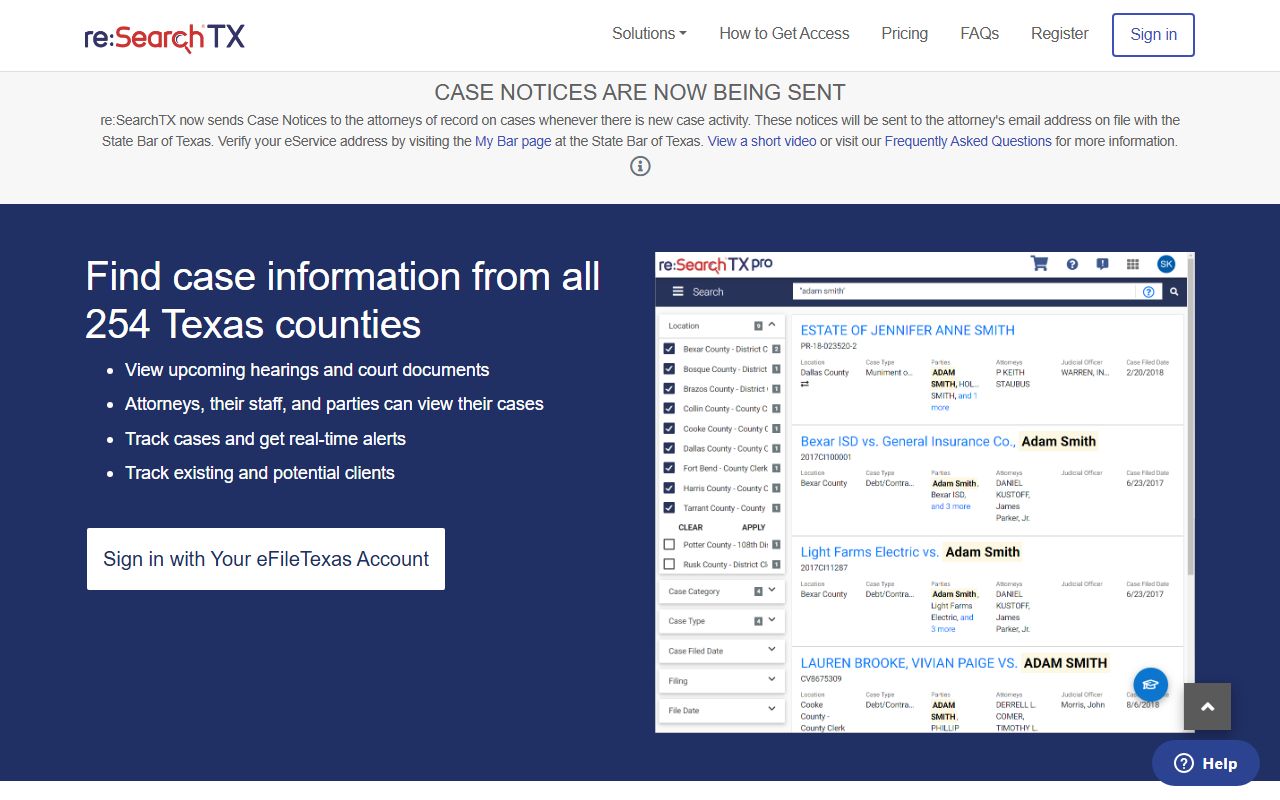
re:SearchTX is the official statewide portal for Texas court records. It works much like the federal PACER system, letting judges, attorneys, and the public find documents that have been e-filed and search for case data from all 254 counties at once. The system launched after years of development. By 2015, all 254 counties were live on eFileTexas for civil e-filing. In 2016, judges began reviewing cases digitally at no cost. By 2018, the Supreme Court issued orders opening access to attorneys and registered users. You can use re:SearchTX to search by party name, cause number, case type, or court. The system shows case status, party names, docket entries, hearing dates, and filed documents where available. There is a free plan that covers many civil cases across district, county, and probate courts. Full document access often requires a paid plan. Not every county has full document access, but the number of participating courts keeps growing. To start, visit research.txcourts.gov and sign in with eFileTexas credentials or create a new account. Support is available by phone at 844.307.8720 or by email at research.support@tylertech.com.
The re:SearchTX portal provides case-level search access to court records from all 254 Texas counties, including civil, criminal, probate, and family cases filed through the eFileTexas system. The re:SearchTX portal, shown below, is the main statewide tool for searching court records across all 254 Texas counties. You can search by name, cause number, case type, or court. The system is free for basic searches and covers civil, criminal, family, and probate cases filed through eFileTexas. Use re:SearchTX to find case information without visiting the courthouse. Sign in with your eFileTexas account or create a new one at research.txcourts.gov. For counties that have uploaded document images, you can view filed documents directly from the portal. Full document access may require a paid subscription plan.
Types of Texas Court Records
Texas court records cover a wide range of legal matters. The type of record you need determines which office holds it. District Clerk offices maintain records for felony criminal cases, civil lawsuits over $200,000, and family law matters including divorce, custody, and child support. County Clerk offices handle misdemeanor cases, probate proceedings, estate filings, guardianships, and county civil cases. Municipal courts handle Class C misdemeanors such as traffic violations and city ordinance violations. Within each court type, several categories of records exist. Civil court records include petitions, motions, orders, and judgments from lawsuits between parties. Family law records include divorce filings, conservatorship orders, protective orders, and child support enforcement. Felony criminal records include indictments, plea agreements, sentencing orders, and probation terms. Probate records cover wills, estate inventories, guardianship filings, and court orders for estate administration. Each record type is filed with a specific clerk and indexed differently, though most can be searched by party name or case number.
Court records in Texas typically include:
- Original petitions or indictments
- Service of process records and answers
- Motions, briefs, and supporting documents
- Court orders and final judgments
- Case dockets tracking all actions and hearings
- Financial disclosures, inventories, and appraisements
- Appeal records and post-judgment documents
eFileTexas and the Electronic Filing System
eFileTexas is the official electronic filing system for Texas courts and the largest state court e-filing system in the country. All 254 counties now e-file documents in civil cases. The system has processed more than 39 million documents and has nearly 255,000 registered users submitting an average of more than 25,000 documents per day. The system is accessible 24/7 from any internet location. It has increased transparency, court efficiency, and use of staff time. When a document is accepted by a clerk through eFileTexas, the user gets a file-marked copy by email. If a document is rejected, the system sends an email with the reason and instructions for fixing the problem. Self-represented parties who don't want to use e-file may still file paper documents at the District Clerk's office or by mail. eFileTexas and re:SearchTX share login credentials, making it easy to manage filings and case lookups from one account.
The eFileTexas system handles all civil court e-filings across all 254 Texas counties and is the foundation for document access through re:SearchTX.
How to Access Texas Court Records
Texas gives you three main ways to access court records: online through official portals, in person at the courthouse, or by mail request. Each method has its own advantages. Online searches are fastest for basic case information like party names, case status, and docket entries. Going to the courthouse in person lets you view the full case file and get certified copies the same day. Mail requests work for people who can't visit in person, though wait times vary by court. To access records online, start with re:SearchTX for a statewide search, or go directly to your county's court website for local results. Many larger counties like Harris, Dallas, Bexar, Travis, and Collin run their own public search portals. For appellate court records, use TAMES (Texas Appeals Management and eFiling System), which lets you search cases from the Supreme Court, Court of Criminal Appeals, and Courts of Appeals. Many appellate files are viewable online at no cost. When visiting the courthouse in person, bring a valid photo ID and any case details you have. Come prepared with the full names of the parties involved, the case number if you have it, and the approximate year of filing. The clerk can search by name or case number and make copies. Standard copies cost $1 per page at most courts. Certified copies cost more, usually $1-$2 per page plus a certification fee that varies by county. Dallas County charges $5 per certification; Tarrant County charges about $1 per page for certified copies.
Public Access to Texas Court Records
Court records in Texas are generally open to the public. Rule 12 of the Texas Rules of Judicial Administration and the Open Courts Provision of the Texas Constitution both support public access. Under these rules, court records are subject to public disclosure unless a court order or a specific statute bars access. You do not have to be a party to the case to request records. You don't need to state why you want them. Most of the case file is open to anyone who asks at the clerk's office. Some records do have restricted access. Juvenile matters are confidential by law. Adoption records are sealed. Records containing sensitive information about minors are often restricted or redacted. Expunged cases are removed from public view. Ongoing investigations may have sealed warrant affidavits before execution. Financial source documents like tax returns can sometimes be sealed in civil cases if a party shows good cause. After a search warrant is executed, the magistrate must make the affidavit available for public inspection in the court clerk's office under Texas law.
It is worth noting that Texas court records are not subject to the Texas Public Information Act. The judiciary is exempt. Instead, access to court records is governed by the Texas Supreme Court through Rule 12, the Open Courts Provision, and specific statutes. Requestors still have broad rights, but the process is handled through the clerk's office rather than through a PIA request to a government body. For more on the Public Information Act as it applies to other government agencies, the Texas A&M Public Information Act guide explains requestor rights and agency duties in detail. Note: Texas court records are exempt from the Public Information Act. Access is governed by the Texas Supreme Court's Rule 12 and the Open Courts Provision, not by PIA procedures.
The Texas A&M Public Information guide outlines how open records laws work in Texas and what rights the public has when requesting government and court-related documents.
Texas State Law Library and Self-Help Resources
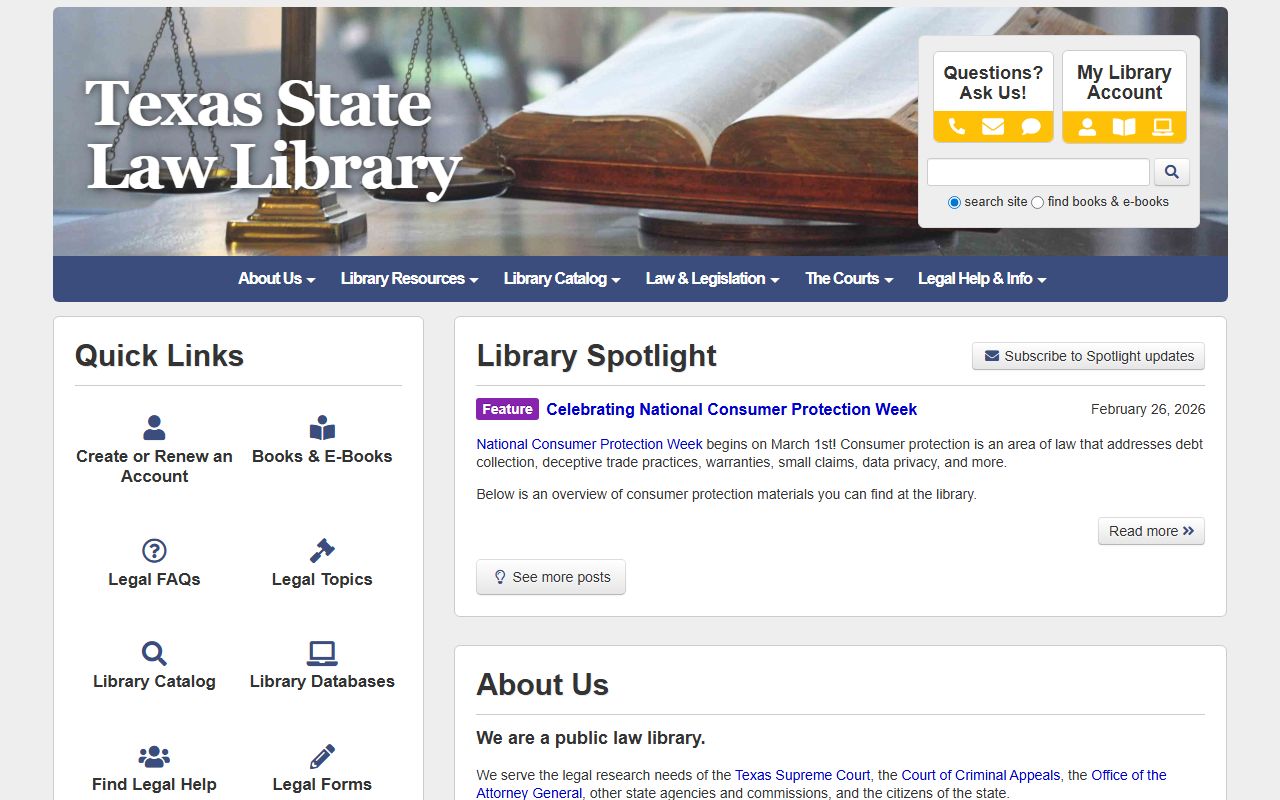
The Texas State Law Library provides public access to legal information and court records resources. The library maintains access to re:SearchTX and helps users register for accounts and search cases. It also runs an Ask a Librarian service where the public can get legal information by email. The library offers self-help materials in English and Spanish, including videos about going through the court system, finding lawyers, accessing forms, and preparing for court dates. For people handling their own cases, the library maintains several key resources. Supreme Court-approved forms for common legal matters are available online. The State Law Library website links to Texas Law Help, which covers different areas of law for people managing simple civil legal matters. The site also includes a live chat service. The library is a good starting point for anyone who needs help finding court records without hiring a lawyer.
The Texas State Law Library is a free public resource for court records research, legal forms, and self-help guides covering all major areas of Texas law. The Texas State Law Library, shown below, provides free public access to legal research tools, court forms, and help with navigating the Texas court system. It also offers an Ask a Librarian email service and maintains a self-help center covering common legal matters. Use the Texas State Law Library website to find Supreme Court-approved forms, access TexasLawHelp, and get guidance on searching court records in any Texas county. Staff can help you navigate the system without providing legal advice.
Finding Court Records by Court Level
Different courts in Texas hold different types of records. The right place to look depends on the type of case. District courts handle felony criminal cases, civil lawsuits over higher dollar thresholds, and family law matters. The District Clerk in each county is the official custodian of those records. County courts at law handle Class A and B misdemeanors, small civil disputes, probate matters, and guardianship cases. The County Clerk keeps those records. For federal court records, Texas residents use the PACER system. Federal district courts in Texas cover the Northern, Southern, Eastern, and Western districts. PACER requires registration, and viewing documents typically costs a small fee. Some federal courthouses have public access terminals at the clerk's office. For appellate records from Texas state courts, use the TAMES system linked from the Texas Judicial Branch website. The Travis County Law Library court records guide explains the process for searching different court types in detail. It breaks down District Clerk records, County Clerk records, Justice of the Peace records, and federal court records, with links to the specific portals for each. Even for people outside Travis County, the guide is a useful reference for understanding how the Texas court system is organized. The Travis County Law Library court records guide is a comprehensive public resource explaining how to search different types of court records across the Texas judicial system.
Legal Help and Attorney Resources
Several organizations offer help with court records and legal matters in Texas. The State Bar of Texas runs a lawyer referral service at (800) 252-9690. You can also search for attorneys by location and practice area through the State Bar's online directory. Lone Star Legal Aid covers east and southeast Texas and handles civil matters for people with low income. Call (800) 733-8394 to check eligibility. Texas RioGrande Legal Aid serves central, south, and west Texas at (888) 988-9996. TexasLawHelp provides self-help guides and official forms for people handling their own legal matters. The Texas Courts website at txcourts.gov maintains all official court forms. Many county courthouses also have a self-help desk or law library where staff can direct you to the right resources, though they cannot provide legal advice. The State Bar eFile update page has information on how attorneys and the public can use eFileTexas and re:SearchTX for court records access.
The State Bar of Texas provides resources for attorneys and the public on e-filing, court records access, and finding qualified legal representation across Texas.
When Court Records Are Confidential
Not all court records in Texas are open to the public. Several categories have restricted access by law. Juvenile court records are confidential. Adoption records are sealed. Expunged criminal records are removed entirely from public access. Records related to mental health commitment proceedings have limited access. Some family law records involving sensitive child information may also be restricted. Texas law also establishes confidentiality rules for certain types of legal proceedings. Under Texas Civil Practice and Remedies Code Chapter 154, communications made during alternative dispute resolution procedures are confidential and cannot be used as evidence. Any record made at an ADR procedure is also confidential. The participants in mediation and similar processes cannot be required to testify about what was said or disclosed during those proceedings. This protects the candid exchange that makes settlement talks work. If you are searching for a record and get no results, the case may be sealed, expunged, or filed under a restricted case type. Some records require a court order for non-parties to access. If you believe a record exists but cannot find it, contact the District Clerk's office directly to ask. They can confirm whether a case is filed under a restricted category without necessarily disclosing the sealed content. The Texas ADR statutes at Justia explain the rules around confidentiality in mediation and other alternative dispute resolution proceedings under Texas Civil Practice and Remedies Code Chapter 154.
Online Guides for Texas Court Records
Several reliable online resources explain how to find Texas court records. It explains in-person, mail, and online options clearly. The site covers trial courts, appellate courts, and how to prepare before visiting a courthouse. Tips include bringing valid photo ID, gathering party names and case numbers before you go, and confirming copy fees by phone ahead of your visit. For any county in Texas, the general pattern for court records access is consistent. The District Clerk handles felony, civil, and family court records. The County Clerk handles misdemeanor, probate, and county court records. Municipal Courts maintain city ordinance and traffic violation records. Most counties participate in re:SearchTX for electronic access to e-filed documents. The Texas Public Information Act procedures apply uniformly to non-judicial government bodies, while court record access is governed separately by the Texas Supreme Court's rules.
Browse Texas Court Records by County
Each of Texas's 254 counties has its own District Clerk and County Clerk that maintain court records for their jurisdiction. Pick a county below to find local clerk contact info, online search portals, and resources for court records in that area. Residents of major Texas cities file cases at the District Court in their county. Pick a city below to find out where to go for court records and how to search cases in that area.